Booster XT Official Website › Blog › Velvet Bean And Medication
Velvet Bean Is A Levodopa Source. Here Is What That Means For Your Medication
One ingredient on this panel is a natural source of a prescription drug. This is the post that costs the product something, and it is the most important thing on this website if you take anything for mood, movement or Parkinson’s disease.
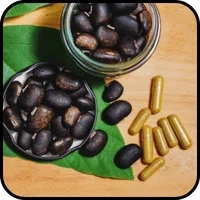
If you take levodopa, a MAO inhibitor, an antipsychotic or a dopamine agonist, do not take this product without speaking to your prescriber first. This is not boilerplate. It follows from one named ingredient on this specific label.
- Velvet bean contains levodopa, the same molecule prescribed for Parkinson’s disease.
- That is why it works in the trials men’s formulas cite, and it is why it interacts.
- No amount is published, so nobody outside the manufacturer knows how much a capsule delivers.
- Four drug classes need a conversation with a prescriber before you add it.
What velvet bean actually is
Mucuna pruriens is a tropical legume. Its seed has been used in Ayurvedic practice for a long time, and in the twentieth century researchers worked out why it does what it does: the seed contains levodopa, usually written L-dopa.
Levodopa is the precursor your body converts into dopamine. It crosses the blood-brain barrier, which dopamine itself does not, and it is the mainstay of Parkinson’s disease treatment for exactly that reason.
So velvet bean is not a herb that happens to have a mild effect on mood. It is a plant source of a prescription drug, at a concentration that varies with the preparation.
What that means in a supplement
Two things follow immediately. First, if a capsule contains a meaningful amount, it has a genuine central effect, which is more than most botanicals in this category can say. Second, everything that interacts with levodopa interacts with it, and the interaction list for levodopa is not short.
The evidence, and what it really shows
Katzenschlager 2004 is the study that matters. It was a double-blind trial in Parkinson’s patients comparing mucuna seed powder against standard levodopa preparation, and it found mucuna behaved like the drug, with a faster onset and a comparable duration of effect. The systematic review of that literature is more recent and reaches similar conclusions about the mechanism.
Read that carefully, because supplement pages usually cite it the other way around. It is not evidence that a botanical produced a surprising benefit. It is evidence that a botanical behaved like the prescription drug it contains.
Shukla 2009 is the study men’s formulas prefer to cite: it examined mucuna and male fertility parameters. It is a real paper, it used seed powder at a stated amount, and it does not change the fact above.
The doses in the Parkinson’s work are large. Those studies used seed powder in the region of fifteen to thirty grams to deliver a therapeutic levodopa dose. No capsule holds that. The point of this post is not that a capsule is a Parkinson’s medication, it is that the same molecule is present in an undisclosed amount.
The four medication classes that matter
| If you take | Why velvet bean matters | What to do |
|---|---|---|
| Levodopa or carbidopa | You would be adding an unknown amount of the same molecule to a carefully titrated dose | Do not take it without your neurologist’s advice |
| A MAO inhibitor | MAO inhibitors and dopaminergic material is a classic interaction and a serious one | Do not take it without medical advice |
| An antipsychotic | Most act by blocking dopamine. Adding a dopamine precursor works directly against that | Ask the prescriber before you order |
| A dopamine agonist | Additive dopaminergic effect, with no way to quantify how much is being added | Ask the prescriber before you order |
None of those four is a theoretical concern dredged up to look thorough. They are the standard interaction set for levodopa, and they apply to a plant source of it for the same pharmacological reason.
Five more worth mentioning at an appointment
- Blood pressure medication. Not because of velvet bean, but because citrulline and grape polyphenols on the same panel both lower blood pressure slightly.
- Nitrates and PDE5 inhibitors. Same nitric oxide pathway as citrulline.
- Anticoagulants. Polyphenols have plausible and poorly quantified effects on platelet behaviour.
- Antidepressants generally. Worth raising even outside the MAO inhibitor class, because dopaminergic material interacts with more than one mechanism.
- Anything for thyroid disease. Maca is a brassica, and raw brassicas contain goitrogens.
The full interaction page sets all nine out in one table, which is the version to take to an appointment.
Read the interaction list before you order.
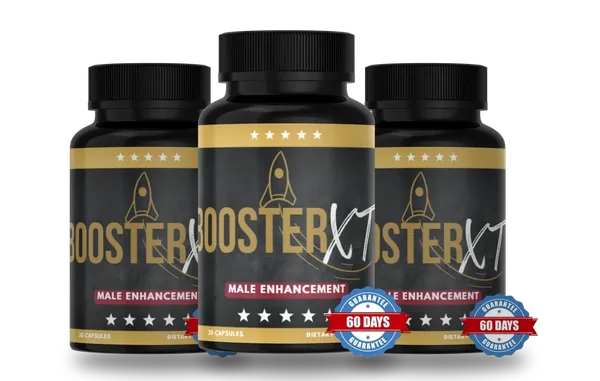
Booster XT names velvet bean on the panel. This website devotes a full page to what that means, because the label does not. Sixty days from purchase to change your mind.
$207 — three bottles at $69 each
Order Booster XT On The Official WebsiteShips from the United States · one charge, no subscription · 60-day money-back guarantee
Why the missing amount makes this worse
If the label printed a milligram figure for the velvet bean extract and a levodopa percentage beside it, this whole question would be answerable with a calculator. A prescriber could work out the levodopa dose in one capsule and tell you whether it mattered against your prescription.
Neither figure is published. That does two things. It makes a clinician’s job harder, because they have to answer conservatively about an unknown. And it removes the possibility of reassurance: with no number, nobody can tell you the amount is trivial, even if it is.
This is the strongest argument on this website for labels that print their amounts, and it is not about efficacy at all. It is about safety, and it is the reason the ingredients page asks the manufacturer for five specific documents, one of which is the levodopa content of this material.
What velvet bean feels like, and does not
Two questions come up whenever this ingredient is explained properly, and both deserve a straight answer.
Will I feel something? At the amounts a six-ingredient capsule can hold, almost certainly not. The Parkinson’s studies used seed powder in the region of fifteen to thirty grams to deliver a therapeutic levodopa dose, and no capsule holds a fraction of one per cent of that. If a men’s supplement did produce a noticeable central effect within an hour, the sensible response would be suspicion rather than satisfaction.
Is it addictive, or does it need cycling? There is no evidence of dependence at supplement amounts and no established reason to cycle it. What is documented, in the Parkinson’s literature at therapeutic doses, is nausea and gastrointestinal upset, and those are dose-related rather than habitual.
The listing artwork for this product says it “promotes healthy dopamine levels”. That line is really a statement about the levodopa in velvet bean, which is why this website declines it as a claim and covers it here as a safety matter instead. An ingredient worth a warning is not automatically an ingredient worth a benefit.
How to raise it with a clinician
- Bring the bottle. Not a photograph of a website. They can read the panel in ten seconds and it removes every ambiguity about what you are asking.
- Lead with the sentence that matters. “It contains Mucuna pruriens, which is a natural levodopa source.” That will get attention faster than the brand name.
- Say that no amounts are published. It changes their answer, and they need to know they are being asked about an unknown quantity rather than a stated one.
- Name the other five ingredients. Two of them affect blood pressure, which matters if you are being treated for it.
- Write the answer down. Including any monitoring they suggest.
Storing it safely if you do take it
Two habits matter more with this formula than with most. Keep it out of reach of children, properly rather than notionally: a bedside drawer is not a cupboard, capsules are not childproof, and a levodopa-bearing botanical has no business anywhere near a child.
And keep the bottle rather than decanting. If anything ever needs raising with a clinician or a pharmacist, the panel in their hand is worth more than your description of it, and the lot code on the base is what connects the bottle to an order.
The balanced view
None of this says velvet bean is dangerous in a supplement. At the amounts a six-ingredient capsule can hold, the levodopa content is probably small, and people have eaten this bean as food for a very long time.
What it says is that this is the one ingredient on the panel with a real pharmacology, and that pharmacology brings a real interaction list with it. An ingredient that can do something can also interact with something. Those are the same property viewed from two sides.
If you take nothing and are in ordinary health, this is background rather than a warning. If you take anything for movement, mood or blood pressure, it is the reason to have a thirty-second conversation before ordering. NCCIH and MedlinePlus are both good neutral starting points, and the who-it-is-for page lists the groups this product is not for at all.
References
- Katzenschlager R, Evans A, Manson A, et al. Mucuna pruriens in Parkinson's disease: a double blind clinical and pharmacological study. J Neurol Neurosurg Psychiatry. 2004;75(12):1672-7. https://pubmed.ncbi.nlm.nih.gov/15548480/
- Hammoud F, et al. Mucuna pruriens Treatment for Parkinson Disease: A Systematic Review of Clinical Trials. Parkinsons Dis. 2025. https://pubmed.ncbi.nlm.nih.gov/40860042/
- Shukla KK, Mahdi AA, Ahmad MK, Shankhwar SN, Rajender S, Jaiswar SP. Mucuna pruriens improves male fertility by its action on the hypothalamus-pituitary-gonadal axis. Fertil Steril. 2009;92(6):1934-40. https://pubmed.ncbi.nlm.nih.gov/18973898/
- National Center for Complementary and Integrative Health. Dietary and Herbal Supplements. https://www.nccih.nih.gov/health/dietary-and-herbal-supplements
- U.S. National Library of Medicine, MedlinePlus. Dietary Supplements. https://medlineplus.gov/dietarysupplements.html
Every page, every journal post, the bottle facts and the ingredients go through review by Dr. Sevann Helo, MD before they ship. The seal beside this line is the manufacturer’s own “Doctor Formulated” mark. It names no clinician and cites no credential, so we do not treat it as a medical review and we have not invented one. What you get instead is a named desk with a method you can check: pages written from the Booster XT label and the paperwork this desk holds, published research linked in the sentence that uses it, and “not published” printed wherever a figure is not disclosed. Corrections are made on the page itself and the review date moves forward. Write to [email protected]. Last reviewed September 2026 by Dr. Sevann Helo, MD.